
Understanding the CO₂ vs. CO Confusion
When we talk about “CO₂ accumulation” inside a car, many people confuse it with carbon monoxide (CO) poisoning.
While both are gases you don’t want in high concentrations, CO₂ (carbon dioxide) is a natural by-product of breathing and is non-toxic at low levels. However, in a confined space like a car cabin, high CO₂ levels can cause drowsiness, reduced alertness, headaches, and slower reaction times — all dangerous for drivers.
Carbon monoxide, on the other hand, is a by-product of combustion and is highly toxic even at small concentrations. The key takeaway: CO₂ build-up is not the same as CO poisoning, but it can still be a safety hazard, especially on long drives.
Why Air Circulation in Cars Has Always Been Taken for Granted
The ability to choose between fresh air intake and internal air recirculation has been a basic feature in vehicles for decades.
Most drivers never question whether it works as intended — it’s assumed to be reliable and effective. That’s why discovering a potential flaw in this system on a modern EV like the BYD Sealion 7 is so concerning.
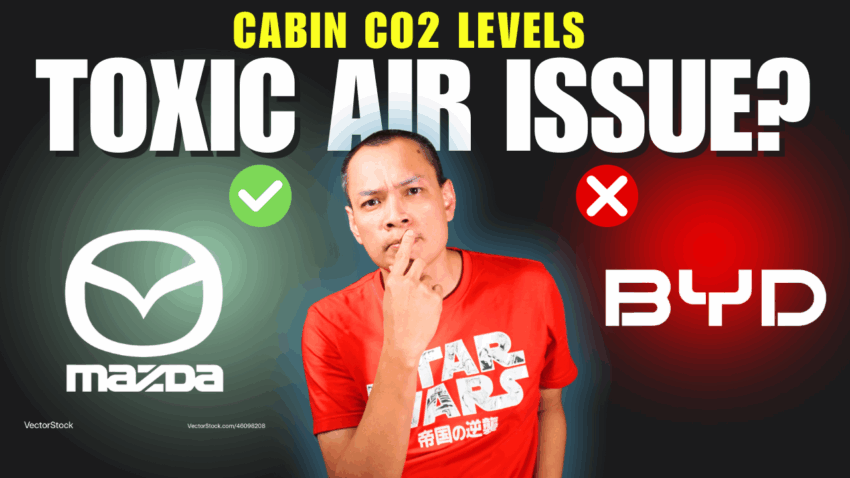
My Test: Mazda 3 vs. Atto 3 vs. Sealion 7
I decided to test three different vehicles under similar driving conditions:
- Mazda 3 (petrol sedan)
- BYD Atto 3 (electric SUV)
- BYD Sealion 7 (electric SUV)
The results were shocking. While the Mazda 3 maintained reasonable in-cabin CO₂ levels, and the Atto 3 performed moderately well, the Sealion 7 showed dangerously high CO₂ accumulation during normal driving — even with fresh air mode enabled.
Raising the Issue with BYD Singapore
I immediately reported my findings to BYD Singapore. They acknowledged the concern and said they would investigate. After a month of back-and-forth communication, their conclusion was surprising:
They claimed that readings from similar Japanese and Korean vehicles were “comparable” to the Sealion 7.
The Missing “Acceptable Range” and Testing Oversight
When I asked BYD what acceptable CO₂ range they were using as a benchmark, they couldn’t give me a number.
Even more frustrating — I later found out that their internal tests were conducted with air recirculation turned on, not with fresh air intake enabled. This completely misses the point of my concern, since recirculation mode naturally leads to higher CO₂ levels over time.
This is a fundamental oversight. The fresh air system exists to maintain safe air quality inside the cabin, and if it fails, drivers may unknowingly be putting themselves at risk.
Why Sealion 7 Owners Should Take This Seriously
I’m urging all BYD Sealion 7 owners to:
- Test your own vehicle using a CO₂ meter, especially on longer drives with fresh air mode enabled.
- Document your results with photos or video.
- Report your findings to your local BYD dealership or distributor.
- Share your experience publicly so this issue gets the attention it deserves.
In-cabin air quality is not just a comfort feature — it’s a safety issue. If enough owners speak up, BYD will be under more pressure to investigate and, if necessary, issue a fix.